Responsible Travel as a tour operator invites you to consider the following guidelines in order to ensure a satisfying experience during your trip to the Galapagos. However, please note that any requirement may change without prior notice, and it is the responsibility of each traveler to ensure compliance with the current entry requirements.
Flights and How to Get to the Galapagos Islands
To reach the Galapagos Islands, flights depart from two main cities in Ecuador: Quito and Guayaquil. Most flights to the Galapagos make a brief stop in Guayaquil before arriving at one of the two island airports: Seymour Galapagos Airport, located on Baltra Island, or San Cristobal Airport. Baltra Island connects easily with Santa Cruz, making inter-island travel simple via ferry or bus, while San Cristobal Island is accessible from the town of Puerto Baquerizo Moreno. Currently, two airlines operate flights from mainland Ecuador to the islands: Avianca and Latam. Flight prices vary for adults and children, and among the different available routes, the following can be found:
- Quito – Galápagos – Quito
- Guayaquil – Galápagos – Guayaquil
- Quito – Galápagos – Guayaquil
- Guayaquil – Galápagos – Quito.
Weather in the Galapagos Islands
The islands have a subtropical climate influenced by the warm El Niño current and the cold Humboldt current, which define two distinct seasons. The highest temperatures are recorded between December and May, with predominantly clear skies and radiant sunshine.
- Rainy Season: From December to May, the weather is characterized by warmer temperatures (between 24 to 29°C), light rainfall, and cloudy skies. This benefits the vegetation and increases the activity of the islands’ native wildlife. Additionally, the sea is warmer and ideal for activities such as diving and snorkeling.
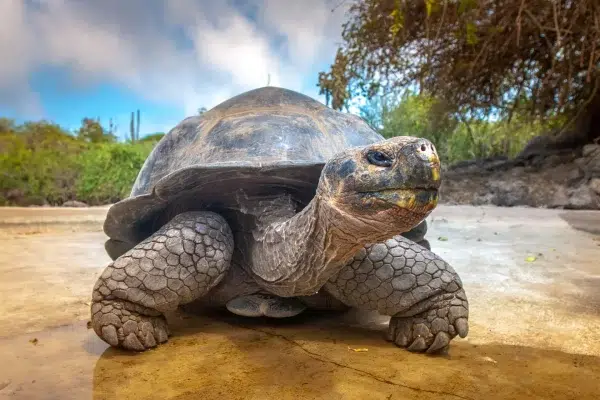
- Dry Season: This season occurs from June to November, with cooler temperatures (between 19 to 24 °C) and cold currents, making the water colder. This favors the observation of species on the islands such as giant tortoises, cormorants, sea lions, lava lizards, and humpback whales.
Entrance Fee to the Galapagos National Park
| FOREIGN TOURISTS | |
|---|---|
| Foreign tourists over 12 years old | US $200 |
| Foreign tourists under 12 years old | US $100 |
| TOURISTS FROM CAN AND MERCOSUR COUNTRIES | |
| Foreign tourists over 12 years old, non-residents of Ecuador, who are nationals of one of the CAN or MERCOSUR countries | US $100 |
| Foreign tourists under 12 years old, non-residents of Ecuador, who are nationals of one of the CAN or MERCOSUR countries | US $50 |
| NATIONAL TOURISTS | |
| Tourists and Nationals residing in Ecuador, for over 12 years | US $30 |
| Tourists and Nationals residing in Ecuador, for over 12 years | US $30 |
| Tourists and foreign nationals residing in Ecuador, under 12 years | US $15 |
| National or foreign tourists residing in Ecuador, over 65 years old | US $15 |
| National or foreign tourists residing in Ecuador, with a disability card issued by CONADIS | US $15 |
| Tourists, foreign students not residing in Ecuador who are enrolled in national educational institutions | US $50 |
| Transient visitors, whether national or foreign and not residing in Ecuador, who are classified by CGREG under this migratory category will pay 50% of the national tourist fee. | US $15 |
Park Rules
When visiting the Galapagos National Park, you must keep in mind the following rules, as it is a protected area.
- When visiting sites within the National Park, you must always be accompanied by a certified guide.
- Galapagos is a unique and fragile environment. Take only photos and videos. Professional filming requires special authorization.
- Please respect the boundaries of the walking trails, for your safety and that of the flora and fauna.
- To avoid disturbing the natural behavior of the local wildlife, you may only approach them up to 2 meters.
- Camping is only allowed in designated areas. If you intend to camp, you must first obtain authorization from the Galapagos National Park.
- The landscapes of the Galapagos are beautiful and unique. Do not spoil them by writing on or carving into rocks or trees.
- Avoid introducing foreign organisms to the islands, as they may have a harmful impact on the ecosystem.
- The animals of the Galapagos have a unique feeding behavior. Never feed the animals. Feeding them could be harmful to their health.
- Do not litter while on the islands. Always dispose of waste safely and appropriately.
- Smoking or lighting fires in the national park areas is prohibited and may cause destructive wildfires.
- Fishing is strictly prohibited, except for those vessels specifically authorized by the Galapagos National Park for this purpose.
- Jet ski rides, submarines, water skiing, and aerial tourism are prohibited.
- Finally, always remember to use authorized tourism services.
Passport Validity Conditions
The passport must be valid for at least half a year. Access is restricted without a valid or officially reported lost document.
Suggested Luggage for Galapagos
Remember to bring the necessary items for your entire stay on the islands. Most importantly, if you are undergoing any medical treatment that requires a specific medication, do not forget to bring enough medicine and consult your doctor. Items to consider including in your luggage:
- Personal Documents: Check the list of documents you need to bring: passport, travel documents, tickets, travel insurance (it is mandatory for traveling to Ecuador), vaccination certificate (if applicable).
- Luggage: If possible, bring one large backpack and one small backpack. If you are traveling within Ecuador using various means of transportation (planes, buses, canoes, etc.), it is necessary to limit your luggage. Any unnecessary luggage can be stored at your hotel in the city. If you are going on an active trip or to the jungle, it is also preferable to carry backpacks instead of suitcases.
- Clothing and Footwear: Bring lightweight and breathable clothing, a windbreaker jacket, swimsuits, a hat or cap, sunglasses, sunscreen, and mosquito repellent. For footwear: 1 pair of walking shoes or sandals, 1 pair of athletic sneakers.
- Equipment: We recommend bringing a waterproof camera or GoPro, binoculars, a reusable water bottle, your own snorkel gear, a flashlight, extra batteries, and waterproof cases for your devices.
Don’t forget the chargers for your cameras. We also recommend that you include an extra memory card for your cameras in your luggage for Galapagos.
Trip Planning for the Galapagos Islands
Located in Ecuador, the Galapagos Islands are influenced by ocean currents that affect the archipelago’s temperatures. For this reason, we present key information to help you plan your trip to the Galapagos so you can make the most of this natural wonder.
- Recommended Duration: To enjoy the biodiversity and activities of the islands, an ideal stay is between 5 and 10 days.
- Types of Tours: There are two popular ways to explore the islands: by cruise or through daily tours offered by hotels from the main islands such as San Cristobal and Santa Cruz.
- Best time to visit: It largely depends on your interests; the wet season is ideal for water activities, while the dry season is recommended for observing marine species.
- Advance Reservations: Due to conservation policies and the limited number of visitors, it is advisable to book accommodations and tours in advance.
Galapagos Islands Information
Language
The official language of Ecuador and the Galapagos Islands is Spanish, although many Indigenous communities in the Andes still use Quichua. However, most workers in the tourism sector, such as hotel and cruise staff, as well as most guides, use English.
Time Zone
Mainland Ecuador (Quito and Guayaquil) is at GMT-5. The Galapagos Islands are at GMT-6. Galapagos follows Central Standard Time.
Currency
Since the year 2000, Ecuador and the Galapagos Islands have used the United States dollar as their official currency.
Vaccinations
To travel to Quito and the Galapagos Islands, no vaccinations are required. However, if you plan to explore mainland Ecuador, the Amazon, or the Coastal Region, we recommend consulting your trusted doctor. Do so well in advance, as some vaccines must be administered at least 3 months before departure.
Travel insurance
It is advisable to purchase medical and travel cancellation insurance to be protected against unexpected situations. Contact your travel agent or local flight provider to find the most convenient offer.
Visas
Tourists from the United States, Canada, Australia, and European nations who arrive in Ecuador for tourism, business, or study purposes do not require a visa, unless they intend to stay in Ecuador for more than 90 days within a calendar year (i.e., 90 days in total across all visits in one year) or if they have income originating from Ecuador. Tourists from these countries will receive a tourist visa for a maximum period of 90 days at the port of entry. List of nationalities that require a visa to enter Ecuador:
| Afghanistan | Angola | Bangladesh | Cameroon |
| Cuba | Egypt | Eritrea | Ethiopia |
| Philippines | Gambia | Ghana | Guinea |
| Kenia | India | Irak | Iran |
| Nigeria | Pakistan | Nepal | Libya |
| Democratic Republic of the Congo | North Korea | Republic of the Congo | República Popular China |
| Sri Lanka | Somalia | Venezuela | Vietnam |
| Haiti | Republica del | Senegal | Yemen |
| Mali | Côte d'Ivoire | Myanmar | Uzbekistan |
| Tajikistan | Albania | Chad | Guinea Bissau |
| Syria | Kirguistán | Mauritania | Sierra Leona |
| Sudán | Sudán del Sur |
Map of the Galapagos Islands and Ecuador
The following images, created by the Ministry of Tourism of Ecuador, illustrate the map of the Galapagos Islands and Ecuador. Additionally, they highlight some of the most frequently visited points of interest, showcasing numerous fascinating tourism themes that captivate cities throughout Ecuador.


The map of the Galapagos Islands displays a variety of larger and smaller islands, each with its own charm and unique biodiversity. Notable places include:
Santa Cruz Island: A tourism hub and inter-island connection point, Santa Cruz is home to the Charles Darwin Research Station, where visitors can learn about conservation and observe giant tortoises. Other notable sites include Tortuga Bay Beach, perfect for swimming and kayaking, and Los Gemelos, vegetation-framed craters ideal for hiking and birdwatching.
Isabela Island: The Sierra Negra Volcano, located on the largest island of the archipelago, is famous for its majestic crater, as well as Los Tuneles, an exclusive spot for snorkeling with turtles and sharks. Puerto Villamil offers serene beaches, while the Wall of Tears blends architecture with the natural environment.
Fernandina Island: The youngest and most pristine island of the Galapagos, Fernandina, is home to numerous colonies of marine iguanas, flightless cormorants, and sea lions at Punta Espinosa. It features a spectacular and unique volcanic landscape.
San Cristobal Island: This island blends nature and culture in places like Cerro Tijeretas, which offers panoramic views and excellent snorkeling, and Leon Dormido, an iconic site for diving with hammerhead sharks and rays. It also features serene beaches such as Playa Mann and El Junco Lagoon, as well as a freshwater lake located in an extinct volcano.